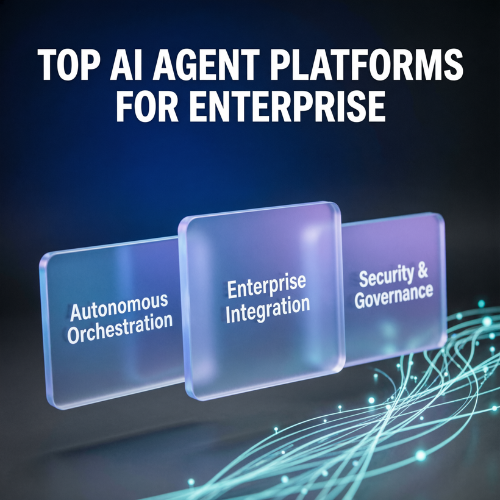
Enterprises are rapidly adopting AI agents to automate complex workflows, enhance productivity, and drive innovation. But with numerous platforms available, choosing the right solution can be challenging.
This comprehensive review covers the top AI agent platforms for enterprise in 2026, helping you make an informed decision.
Evaluation Criteria
We assessed platforms based on:
- Scalability: Ability to handle enterprise workloads.
- Security & Compliance: Data protection and regulatory adherence.
- Integration: Compatibility with existing enterprise systems.
- Customization: Flexibility to build tailored agents.
- Support & SLA: Enterprise-grade support and reliability.
- Total Cost of Ownership: Pricing transparency and ROI potential.
1. Microsoft Copilot Studio
Overview: Microsoft’s enterprise agent platform integrated with the Microsoft 365 ecosystem, enabling organizations to build custom agents with deep Office integration.
Key Features:
- Seamless Microsoft 365 integration
- Azure AI foundation models
- Enterprise-grade security and compliance
- Multi-agent orchestration
- Power Platform connectors
Best For: Organizations heavily invested in Microsoft ecosystem.
Pros:
- Deep integration with Office, Teams, SharePoint
- Strong security and compliance certifications
- Familiar interface for Microsoft users
- Extensive connector library
Cons:
- Less flexible for non-Microsoft environments
- Can be expensive for large deployments
Pricing: Per-user licensing; enterprise agreements available.
Rating: ⭐⭐⭐⭐⭐ (4.7/5)
2. Google Vertex AI Agent Builder
Overview: Google Cloud’s comprehensive platform for building, deploying, and managing AI agents with advanced multimodal capabilities.
Key Features:
- Gemini model integration
- Grounding with enterprise data
- Multi-modal agent capabilities
- Vertex AI pipelines
- Advanced monitoring and evaluation
Best For: Data-driven enterprises leveraging Google Cloud.
Pros:
- Powerful multimodal capabilities
- Excellent data grounding features
- Scalable infrastructure
- Strong ML operations tools
Cons:
- Steeper learning curve
- Requires Google Cloud adoption
Pricing: Pay-as-you-go; enterprise discounts available.
Rating: ⭐⭐⭐⭐⭐ (4.6/5)
3. AWS Bedrock Agents
Overview: Amazon’s fully managed service for creating AI agents that can execute multi-step tasks using foundation models and enterprise data.
Key Features:
- Multiple model providers (Anthropic, Meta, Amazon)
- Automatic task decomposition
- Integration with AWS services
- Enterprise security controls
- Cost optimization features
Best For: AWS-centric enterprises requiring flexibility in model choice.
Pros:
- Model provider flexibility
- Seamless AWS integration
- Strong security and governance
- Competitive pricing
Cons:
- AWS lock-in concerns
- Documentation can be complex
Pricing: Usage-based; reserved capacity options.
Rating: ⭐⭐⭐⭐ (4.5/5)
4. Salesforce Agentforce
Overview: Salesforce’s AI agent platform built into the Customer 360 ecosystem, focused on customer service, sales, and marketing automation.
Key Features:
- Native CRM integration
- Pre-built agent templates
- Einstein Trust Layer
- Multi-agent collaboration
- Real-time analytics
Best For: Customer-facing enterprises using Salesforce CRM.
Pros:
- Unmatched CRM integration
- Quick deployment with templates
- Strong focus on customer experience
- Trusted data governance
Cons:
- Limited outside Salesforce ecosystem
- Premium pricing
Pricing: Per-agent licensing; add-on to Salesforce subscriptions.
Rating: ⭐⭐⭐⭐ (4.4/5)
5. IBM watsonx Orchestrate
Overview: IBM’s enterprise AI platform for building and managing AI agents with strong focus on governance, compliance, and hybrid cloud deployment.
Key Features:
- Hybrid cloud deployment
- Enterprise governance framework
- Industry-specific solutions
- Multi-model support
- Advanced audit trails
Best For: Regulated industries requiring strict governance.
Pros:
- Excellent governance and compliance
- Hybrid cloud flexibility
- Industry expertise
- Strong enterprise support
Cons:
- Higher implementation complexity
- Smaller developer community
Pricing: Enterprise licensing; custom quotes.
Rating: ⭐⭐⭐⭐ (4.3/5)
6. ServiceNow Now Assist Agents
Overview: ServiceNow’s AI agent platform integrated with the Now Platform, automating IT, HR, and customer service workflows.
Key Features:
- Workflow automation focus
- ITSM and HR integration
- Pre-built skill library
- Human-in-the-loop controls
- Performance analytics
Best For: Enterprises using ServiceNow for workflow management.
Pros:
- Deep workflow integration
- Strong IT and HR use cases
- Quick time-to-value
- Reliable enterprise platform
Cons:
- Limited outside ServiceNow use cases
- Licensing can be complex
Pricing: Add-on to ServiceNow licenses.
Rating: ⭐⭐⭐⭐ (4.4/5)
Comparison Table
| Platform | Best For | Integration | Security | Ease of Use | Pricing |
|---|---|---|---|---|---|
| Copilot Studio | Microsoft shops | ⭐⭐⭐⭐⭐ | ⭐⭐⭐⭐⭐ | ⭐⭐⭐⭐ | $ |
| Vertex AI | Google Cloud | ⭐⭐⭐⭐ | ⭐⭐⭐⭐⭐ | ⭐⭐⭐ | $$ |
| AWS Bedrock | AWS users | ⭐⭐⭐⭐⭐ | ⭐⭐⭐⭐⭐ | ⭐⭐⭐ | $$ |
| Agentforce | Salesforce CRM | ⭐⭐⭐⭐⭐ | ⭐⭐⭐⭐ | ⭐⭐⭐⭐ | $$ |
| watsonx | Regulated industries | ⭐⭐⭐ | ⭐⭐⭐⭐⭐ | ⭐⭐ | $$ |
| ServiceNow | Workflow automation | ⭐⭐⭐⭐ | ⭐⭐⭐⭐ | ⭐⭐⭐⭐ | $ |
Implementation Best Practices
1. Start with Clear Use Cases
Identify high-impact workflows that benefit from automation. Prioritize based on ROI and feasibility.
2. Ensure Data Readiness
- Audit and clean enterprise data.
- Establish data governance policies.
- Implement proper access controls.
3. Plan for Integration
- Map existing systems and APIs.
- Design integration architecture.
- Test connectivity and data flow.
4. Establish Governance
- Define agent behavior policies.
- Implement monitoring and audit trails.
- Create escalation procedures.
5. Train Your Team
- Upskill IT and business users.
- Create documentation and playbooks.
- Establish center of excellence.
Security and Compliance Considerations
- Data Residency: Ensure data stays in required geographic regions.
- Access Controls: Implement role-based access and least privilege.
- Audit Trails: Maintain comprehensive logs of agent actions.
- Compliance Certifications: Verify SOC 2, ISO 27001, GDPR, HIPAA as needed.
- Model Governance: Track model versions and performance.
ROI Calculation Framework
Calculate expected ROI using:
ROI = (Benefits - Costs) / Costs × 100

Benefits:
- Labor cost savings
- Productivity gains
- Error reduction
- Faster resolution times
- Improved customer satisfaction

Costs:
- Platform licensing
- Implementation services
- Training and change management
- Ongoing maintenance
- Compute and API costs
Conclusion
Choosing the right enterprise AI agent platform depends on your existing technology stack, use cases, compliance requirements, and budget. In 2026:
- Microsoft Copilot Studio leads for Microsoft-centric organizations.
- Google Vertex AI excels in multimodal capabilities.
- AWS Bedrock offers model flexibility.
- Salesforce Agentforce dominates customer-facing workflows.
- IBM watsonx is ideal for regulated industries.
- ServiceNow shines for workflow automation.
Evaluate your specific needs, run pilot programs, and choose the platform that aligns with your enterprise strategy.
👉 Related Resources: