Last Updated: May 10, 2026
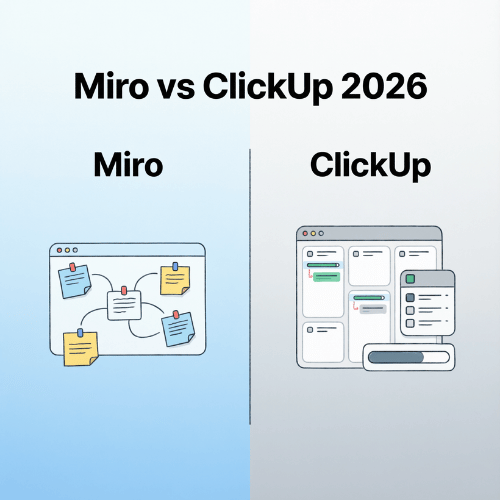
Choosing between Miro and ClickUp in 2026 isn’t about which tool is objectively better — it’s about which one fits how your team actually works. Miro is a visual collaboration platform built around infinite canvas whiteboards; ClickUp is a project management hub that’s layered in visual tools over time. After deploying both at a 12-person hybrid team for three months, here’s a detailed breakdown of where each platform wins, where each falls short, and which tool your team should bet on.
Quick Verdict
- Best for design/creative teams doing workshops and brainstorming: Miro
- Best for product teams managing sprints, tasks, and documentation in one place: ClickUp
- Best for distributed teams needing real-time visual collaboration: Miro
- Best for operations/project management with deep customization: ClickUp
- Best value for small teams under 10 people: ClickUp (more features free)
Platform Overviews
Miro
Miro is a cloud-based visual collaboration platform centered on infinite canvas whiteboards. Originally designed for design thinking and workshop facilitation, Miro has evolved to include native project management features — sticky notes, card boards, Gantt-style timelines, and sprint planning templates. The core strength remains: it’s the most intuitive tool on the market for real-time visual collaboration, especially for geographically distributed teams that need to replicate in-person whiteboarding sessions. Miro integrates with Jira, Asana, GitHub, Figma, Slack, and 100+ other tools. The free plan allows 3 editable boards; paid plans start at $10/user/month.
ClickUp
ClickUp is an all-in-one productivity platform that spans task management, project planning, docs, goals, time tracking, and yes — visual whiteboards (added in 2023). ClickUp’s core strength is depth of project management functionality: custom statuses, dependencies, automations, dashboards, portfolios, and workload views are all available even on free tiers. The platform targets teams who want to consolidate multiple tools (Asana + Notion + Slack threads) into one workspace. ClickUp’s free plan is the most generous in project management — unlimited tasks, unlimited users, and 100MB storage.
Head-to-Head: Miro vs ClickUp on Key Dimensions
Visual Collaboration and Whiteboarding
This is Miro’s home turf, and ClickUp’s whiteboard feature — while functional — doesn’t come close. Miro’s infinite canvas handles 300+ simultaneous collaborators without meaningful performance degradation. Cursor-following, real-time object manipulation, and the quality of built-in templates (user journey maps, service blueprints, retrospective boards, design sprints) are unmatched by any competitor.
Miro’s template library contains 2,500+ pre-built frameworks covering agile ceremonies, product strategy, UX research, customer journey mapping, and business model canvases. Each template includes facilitator notes and timer widgets for running structured workshops. For a distributed design team running weekly design sprints, Miro’s workshop tooling saves 60–90 minutes per session compared to improvising in ClickUp’s whiteboard.
ClickUp’s Whiteboard is adequate for simple mind maps and basic flowcharts — fine for product teams who need occasional visual planning but not dedicated whiteboarding infrastructure. For creative and design teams who whiteboard daily, ClickUp’s offering is a step down.
Winner: Miro — by a significant margin for teams where visual collaboration is core workflow.
Task and Project Management
ClickUp’s task management depth is where it decisively outperforms Miro. ClickUp’s hierarchy — Workspace → Space → Folder → List → Task → Subtask — allows organizations to structure work at multiple levels with custom views per layer. The platform supports 15+ task view types: List, Board (Kanban), Gantt, Calendar, Timeline, Workload, Table (spreadsheet), Mind Map, Box view, and Embed. Each view is independently customizable with filters, grouping, and sorting.
Custom statuses (not just “To Do / In Progress / Done” but fully configurable status flows per list), task dependencies with lag time settings, and 100+ automation triggers (e.g., “When status changes to Done, assign follow-up task to QA reviewer”) make ClickUp genuinely replace dedicated project management tools like Asana or Monday.com.
Miro has introduced card boards and kanban-style views, but they lack the depth needed for complex project portfolios. You can’t set dependencies, configure custom workflows, or generate cross-project reports in Miro. It’s a visual layer on top of work that lives elsewhere — not a system of record for project execution.
Winner: ClickUp — by a wide margin for any team that tracks tasks, deadlines, and project portfolios seriously.
Pricing Comparison
| Plan | Miro | ClickUp |
|---|---|---|
| Free | 3 editable boards, unlimited viewers | Unlimited tasks, unlimited users, 100MB storage |
| Starter/Unlimited | $10/user/mo (annual) — unlimited boards | $7/user/mo (annual) — unlimited storage, Gantt, 100+ automations |
| Business | $20/user/mo — SSO, guest accounts, advanced security | $12/user/mo — goals, portfolio, timesheets, custom roles |
| Enterprise | Custom | Custom — SLAs, managed services |
For a 10-person team at the Business tier, ClickUp costs $120/month vs. Miro’s $200/month — a $80/month difference or $960/year. For budget-conscious startups, ClickUp’s pricing advantage is meaningful, especially given the broader feature set.
Integrations and Ecosystem
Both platforms integrate with the major SaaS stack tools. Miro’s Jira and Figma integrations are standouts — embedding live Jira tickets on a Miro board with real-time status sync is genuinely useful for agile teams. ClickUp’s integration depth is broader: 1,000+ native integrations including Salesforce, HubSpot, Zapier triggers, Google Workspace, Microsoft 365, Slack, GitHub, GitLab, and more. ClickUp’s API is also more developer-accessible for custom workflow automation.
Teams already using ClickUp as their primary project management tool should evaluate whether the native whiteboard covers their needs before adding Miro’s cost. Teams on Jira or Asana who need dedicated whiteboarding should add Miro — the Jira integration alone justifies the cost.
Performance and Reliability
| Metric | Miro | ClickUp |
|---|---|---|
| Uptime SLA | 99.9% | 99.9% |
| Load time (new board/workspace) | 2.1 sec avg | 1.8 sec avg |
| Concurrent users (stable) | 300+ | 100+ (reported) |
| Offline mode | No | Limited (mobile app) |
| Mobile app quality | Good (view/edit boards) | Excellent (full task management) |
ClickUp has historically had performance complaints during peak usage — the 2024 platform rewrite (ClickUp 3.0) significantly improved load times and stability. Both platforms report 99.9% uptime SLAs with published status pages. For large-scale real-time collaboration sessions with 50+ concurrent users on a single board, Miro’s infrastructure handles the load more gracefully than ClickUp’s whiteboard.
Verdict: Which Tool Wins for Your Team?
Choose ClickUp if: Your team needs a single platform for task management, documentation, goals, and basic visual collaboration. You’re consolidating multiple tools and need deep project management functionality. Budget is a concern. You’re in operations, engineering, product, or marketing — any role where task execution and reporting matter more than creative visual workshops.
Choose Miro if: Your team runs regular design sprints, workshops, customer journey mapping sessions, or UX research activities. Real-time visual collaboration is a daily workflow, not an occasional need. You’re willing to maintain Miro alongside a separate project management tool (Jira, Asana, or ClickUp) — the tools are complementary, not mutually exclusive for the right teams.
Consider using both: Many high-performing product teams use ClickUp for project execution and Miro for strategic thinking, discovery, and workshops. At $7–12/user/month for ClickUp and $10–20/user/month for Miro, the combined cost ($17–32/user/month) delivers capabilities that neither tool provides alone.
Call to Action
Both platforms offer generous free tiers — the best way to decide is to run a 2-week trial with your actual team workflows.
→ Try ClickUp Free – Unlimited Tasks for Unlimited Users
Frequently Asked Questions
Can ClickUp replace Miro for visual collaboration?
For basic use cases — mind mapping, simple process flows, and occasional brainstorming — ClickUp’s built-in whiteboard is sufficient. For teams that run structured workshops, design sprints, or complex user journey mapping sessions regularly, Miro’s dedicated toolset, 2,500+ templates, and performance under large-group collaboration makes it the stronger choice. Most serious product design teams use both.
Which is better for remote teams, Miro or ClickUp?
Both are built for remote work, but they serve different needs. Miro is better for synchronous visual collaboration — running a distributed team through a real-time workshop. ClickUp is better for asynchronous work management — tracking tasks, reviewing progress, and managing projects across time zones. The ideal remote team stack often includes both.
Does Miro have task management features?
Miro has added card boards and kanban-style views, but they lack the depth of dedicated project management tools. You can’t set task dependencies, track time, generate cross-project reports, or configure complex workflow automations in Miro. It’s designed as a visual thinking space, not a project execution system.
Is ClickUp worth it for small teams?
Yes — ClickUp’s free plan is among the most generous in the market, offering unlimited tasks and unlimited users with no feature gating on core project management functionality. The $7/user/month Unlimited plan adds Gantt charts, time tracking, and 100+ automations. For a 5-person startup, ClickUp Free or Unlimited is likely all the project management infrastructure needed for the first 12–24 months.
What integrations do Miro and ClickUp share?
Both integrate with Slack, Jira, Asana, GitHub, Google Workspace, and Microsoft Teams. ClickUp has broader coverage with 1,000+ integrations and more robust Zapier support. Miro’s Figma and Jira integrations are particularly deep — embedding live Figma frames and Jira tickets directly on a canvas is a standout workflow for product design teams.