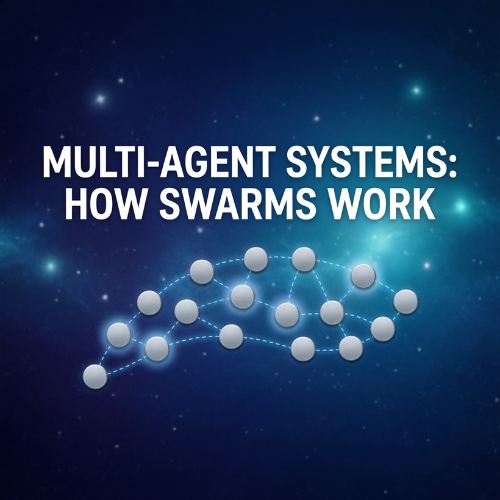
Single agents are powerful, but multi-agent systems unlock a new level of capability. By coordinating multiple specialized agents, organizations can solve complex problems that no single agent could handle alone.
In this article, we explore how AI swarms work, their architectures, and real-world applications transforming industries in 2026.
What Are Multi-Agent Systems?
A multi-agent system (MAS) is a collection of autonomous agents that interact and collaborate to achieve individual or collective goals. Each agent may have specialized capabilities, and together they form a coordinated system capable of tackling complex tasks.
Key Characteristics:
- Decentralization: No single point of control; agents operate independently.
- Specialization: Agents have distinct roles and expertise.
- Communication: Agents exchange information to coordinate actions.
- Emergence: Collective behavior produces results greater than the sum of individual actions.
How AI Swarms Work
1. Agent Roles and Specialization
In a swarm, each agent is assigned a specific role:
- Coordinator/Manager: Orchestrates tasks and delegates work.
- Specialist Agents: Handle specific domains (e.g., research, coding, validation).
- Critic/Reviewer: Evaluates outputs and provides feedback.
- Executor: Carries out final actions or deployments.
2. Communication Protocols
Agents communicate through structured protocols:
- Message Passing: Direct communication between agents.
- Shared Memory: Agents read/write to a common knowledge base.
- Blackboard Systems: Central repository where agents post and retrieve information.
- Broadcast: Agents announce updates to all participants.
3. Coordination Mechanisms
- Hierarchical: Top-down control with manager agents directing subordinates.
- Democratic: Agents vote or negotiate to make decisions.
- Market-Based: Agents bid for tasks based on capabilities and availability.
- Stigmergy: Indirect coordination through environmental modifications (inspired by ant colonies).
Multi-Agent Architectures
Hierarchical Architecture
Manager Agent
    ├── Research Agent
    ├── Analysis Agent
    └── Report Agent
Best for structured workflows with clear task delegation.
Peer-to-Peer Architecture
Agent A ↔ Agent B ↔ Agent C
    ↕         ↕         ↕
Agent D ↔ Agent E ↔ Agent F
Ideal for decentralized systems requiring flexibility and resilience.
Hybrid Architecture
Combines hierarchical and peer-to-peer elements for balanced control and autonomy.
Benefits of Multi-Agent Systems
| Benefit | Description |
|---|---|
| Scalability | Add more agents to handle increased workload. |
| Resilience | System continues operating if individual agents fail. |
| Efficiency | Parallel processing accelerates task completion. |
| Specialization | Each agent excels at its designated role. |
| Flexibility | Easily reconfigure agents for new tasks. |
Real-World Use Cases
1. Software Development Swarms
- Product Manager Agent: Defines requirements.
- Architect Agent: Designs system structure.
- Coder Agents: Write code for different modules.
- Tester Agent: Validates and reports bugs.
- DevOps Agent: Handles deployment and monitoring.
2. Research and Analysis Teams
- Data Collector Agents: Gather information from multiple sources.
- Analyst Agents: Process and interpret data.
- Synthesis Agent: Combines findings into coherent reports.
- Fact-Checker Agent: Verifies accuracy and citations.
3. Customer Service Operations
- Triage Agent: Categorizes and prioritizes inquiries.
- Resolution Agents: Handle specific issue types.
- Escalation Agent: Manages complex cases requiring human help.
- Feedback Agent: Collects and analyzes customer satisfaction.
4. Supply Chain Optimization
- Demand Forecasting Agent: Predicts inventory needs.
- Procurement Agent: Manages supplier relationships.
- Logistics Agent: Optimizes shipping routes.
- Risk Agent: Monitors disruptions and suggests mitigations.
Challenges in Multi-Agent Systems
- Coordination Overhead: Communication can become complex as agent count grows.
- Conflict Resolution: Agents may have competing objectives or contradictory outputs.
- Resource Management: Efficiently allocating compute and memory across agents.
- Debugging Difficulty: Tracing issues in decentralized systems is challenging.
- Security Risks: More agents mean larger attack surface.
Best Practices for Implementation
- Define Clear Roles: Ensure each agent has a well-defined purpose.
- Establish Communication Standards: Use consistent message formats and protocols.
- Implement Monitoring: Track agent performance and system health.
- Design for Failure: Build redundancy and graceful degradation.
- Start Small: Begin with 2-3 agents before scaling to larger swarms.
- Use Proven Frameworks: Leverage AutoGen, LangGraph, or CrewAI for orchestration.
Tools and Frameworks for Multi-Agent Development
- AutoGen: Excellent for conversation-based multi-agent systems.
- LangGraph: Provides fine-grained control over agent graphs.
- CrewAI: Simplifies role-based agent team creation.
- Ray: Distributed computing framework for scaling agent workloads.
The Future of AI Swarms
As we advance through 2026, expect to see:
- Self-Organizing Swarms: Agents that dynamically form teams based on task requirements.
- Cross-Platform Collaboration: Agents from different organizations working together securely.
- Human-Agent Teams: Seamless integration of humans and agents in collaborative workflows.
- Swarm Learning: Collective knowledge sharing across agent networks.
Conclusion
Multi-agent systems represent a paradigm shift in AI capabilities. By leveraging swarm intelligence, organizations can tackle complex challenges with unprecedented efficiency and resilience.
Whether you’re building development teams, research swarms, or customer service operations, understanding multi-agent architectures is essential for harnessing the full potential of autonomous AI.
👉 Dive Deeper: