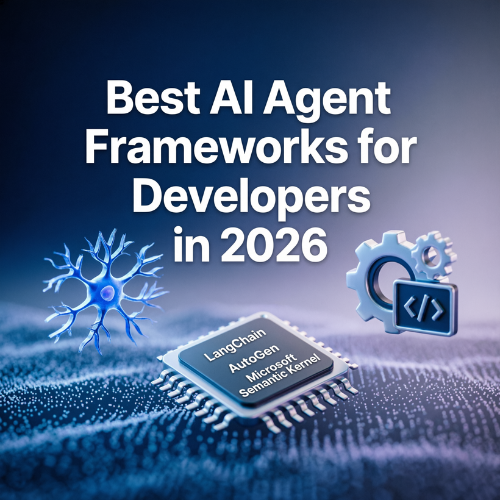
Building AI agents requires robust frameworks that handle orchestration, memory, tool integration, and multi-agent coordination. In 2026, the developer ecosystem has matured significantly, offering powerful options for every use case.
This guide compares the best AI agent frameworks available, helping you choose the right tool for your project.
Top AI Agent Frameworks in 2026
1. LangGraph
Overview: Developed by LangChain, LangGraph is a framework for building stateful, multi-actor agents using a graph-based architecture.
Key Features:
- Graph-based workflow definition
- Fine-grained control over agent behavior
- Built-in persistence and memory
- Seamless integration with LangChain ecosystem
Best For: Complex workflows requiring precise control and state management.
Pros:
- Highly flexible and customizable
- Excellent documentation and community
- Production-ready with monitoring tools
Cons:
- Steeper learning curve
- Can be verbose for simple agents
Pricing: Open-source core; LangSmith for monitoring (paid tiers).
2. AutoGen (Microsoft)
Overview: AutoGen enables the creation of multi-agent conversations where agents collaborate to solve tasks through structured dialogue.
Key Features:
- Multi-agent conversation framework
- Code execution capabilities
- Human-in-the-loop support
- Customizable agent roles
Best For: Multi-agent systems and collaborative problem-solving.
Pros:
- Powerful multi-agent coordination
- Strong code execution features
- Active research backing from Microsoft
Cons:
- Complexity increases with agent count
- Resource-intensive for large swarms
Pricing: Open-source.
3. CrewAI
Overview: CrewAI focuses on role-based agent design, making it intuitive to create teams of specialized agents working toward common goals.
Key Features:
- Role-based agent definition
- Task delegation and collaboration
- Simple, developer-friendly API
- Built-in process management
Best For: Business automation and team-based agent workflows.
Pros:
- Easy to learn and implement
- Clean, intuitive syntax
- Great for rapid prototyping
Cons:
- Less flexible for highly custom architectures
- Smaller ecosystem compared to LangChain
Pricing: Open-source; CrewAI Enterprise available.
4. Haystack Agents
Overview: Part of the Haystack framework by deepset, Haystack Agents excel at retrieval-augmented workflows and document processing.
Key Features:
- Strong RAG integration
- Pipeline-based architecture
- Tool-augmented agents
- Enterprise-grade reliability
Best For: Document-heavy applications and enterprise search.
Pros:
- Excellent for RAG pipelines
- Production-ready
- Strong enterprise support
Cons:
- Less suited for general-purpose agents
- Smaller multi-agent capabilities
Pricing: Open-source; deepset Cloud for managed service.
5. Semantic Kernel (Microsoft)
Overview: A lightweight SDK that integrates LLMs with conventional programming languages, enabling AI agent development in C#, Python, and Java.
Key Features:
- Multi-language support
- Plugin-based architecture
- Enterprise integration
- Memory and planning capabilities
Best For: Enterprise applications and Microsoft ecosystem integration.
Pros:
- Strong enterprise features
- Multi-language flexibility
- Microsoft backing and support
Cons:
- Smaller community than Python-first frameworks
- Documentation can be fragmented
Pricing: Open-source.
Comparison Table
| Framework | Multi-Agent | Learning Curve | Best Use Case | Ecosystem |
|---|---|---|---|---|
| LangGraph | ✅ Yes | Medium-High | Complex workflows | ⭐⭐⭐⭐⭐ |
| AutoGen | ✅✅ Excellent | Medium | Agent collaboration | ⭐⭐⭐⭐ |
| CrewAI | ✅ Yes | Low | Business automation | ⭐⭐⭐ |
| Haystack | ⚠️ Limited | Low-Medium | RAG & Documents | ⭐⭐⭐⭐ |
| Semantic Kernel | ✅ Yes | Medium | Enterprise apps | ⭐⭐⭐ |
How to Choose the Right Framework
Consider These Factors:
- Project Complexity: Simple tasks may only need CrewAI; complex workflows benefit from LangGraph.
- Team Expertise: Python teams may prefer LangGraph/AutoGen; .NET teams should consider Semantic Kernel.
- Multi-Agent Needs: AutoGen excels at agent collaboration; LangGraph offers more control.
- Enterprise Requirements: Semantic Kernel and Haystack offer strong enterprise features.
- Community & Support: LangChain/LangGraph has the largest ecosystem and resources.
Getting Started Tips
- Start with Tutorials: Each framework offers excellent getting-started guides.
- Build a MVP: Create a simple agent before scaling to complex systems.
- Join Communities: Discord and GitHub communities are invaluable for support.
- Monitor Performance: Use tools like LangSmith or custom logging to track agent behavior.
Conclusion
The best AI agent framework depends on your specific needs, team expertise, and project requirements. In 2026, LangGraph leads for flexibility, AutoGen dominates multi-agent collaboration, and CrewAI shines for business automation.
Evaluate your use case, experiment with a few options, and choose the framework that aligns with your goals.
👉 Related Reads: