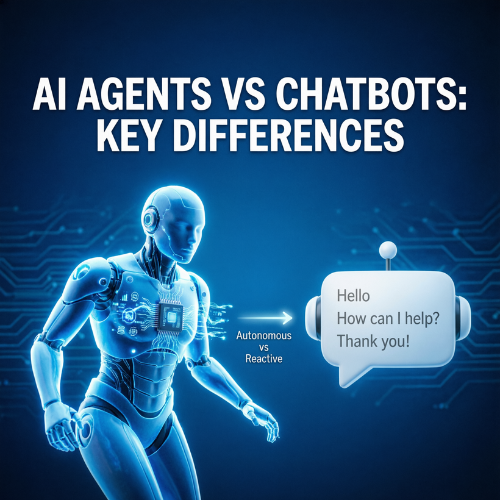
The terms “AI agent” and “chatbot” are often used interchangeably, but they represent fundamentally different technologies. In 2026, understanding this distinction is crucial for businesses and developers making AI investment decisions.
This article breaks down the key differences between AI agents and chatbots, helping you choose the right solution for your needs.
Quick Comparison
| Aspect | Chatbots | AI Agents |
|---|---|---|
| Primary Function | Conversation & Q&A | Task execution & goal achievement |
| Autonomy | Reactive (user-driven) | Proactive (self-directed) |
| Tool Access | Limited or scripted | Extensive & dynamic |
| Memory | Session-based context | Long-term persistent memory |
| Decision Making | Predefined flows or simple responses | Complex reasoning & planning |
| Outcome | Information or conversation | Completed tasks & actions |
| Human Oversight | Continuous interaction required | Minimal supervision needed |
What Is a Chatbot?
A chatbot is a conversational interface designed to interact with users through text or voice. Traditional chatbots follow scripted flows, while AI-powered chatbots use LLMs to generate responses.
Characteristics:
- Reactive: Waits for user input before responding.
- Conversation-Focused: Primary goal is dialogue.
- Limited Actions: May trigger simple predefined actions.
- Short-Term Context: Remembers conversation history within a session.
Common Use Cases:
- FAQ answering
- Basic customer support
- Lead qualification
- Simple information retrieval
What Is an AI Agent?
An AI agent is an autonomous system capable of perceiving, reasoning, and acting to achieve specific goals. Agents can initiate actions, use tools, and operate with minimal human intervention.
Characteristics:
- Proactive: Can initiate actions based on goals or triggers.
- Task-Focused: Primary goal is completing objectives.
- Extensive Tool Use: Dynamically selects and uses tools.
- Long-Term Memory: Learns and remembers across sessions.
- Adaptive: Adjusts behavior based on feedback and environment.
Common Use Cases:
- End-to-end workflow automation
- Complex research and analysis
- Autonomous coding and deployment
- Multi-step business processes
Key Differences Explained
1. Autonomy Level
Chatbots: Require continuous user interaction. Each response depends on user input.
AI Agents: Can operate independently once given a goal. They plan, execute, and adapt without constant guidance.
2. Tool Integration
Chatbots: Limited to predefined integrations. Actions are typically hardcoded.
AI Agents: Dynamically select and use tools based on context. Can learn to use new tools and combine them creatively.
3. Reasoning Capability
Chatbots: Generate responses based on patterns and context. Limited planning ability.
AI Agents: Perform multi-step reasoning, break down complex goals, and make decisions about action sequences.
4. Memory and Learning
Chatbots: Context window limited to conversation. No persistent learning.
AI Agents: Maintain long-term memory, learn from experiences, and improve over time.
5. Error Handling
Chatbots: May hallucinate or provide incorrect information. Limited recovery mechanisms.
AI Agents: Can detect errors, retry actions, seek clarification, and adapt strategies.
When to Use Chatbots
Chatbots are still valuable for:
- Simple Q&A: Answering frequently asked questions.
- Initial Triage: Collecting information before escalation.
- Guided Flows: Structured interactions like booking or ordering.
- Cost-Effective Solutions: Lower complexity and resource requirements.
- Human Handoff: Smooth transition to human agents when needed.
When to Use AI Agents
Choose AI agents for:
- Complex Workflows: Multi-step processes requiring coordination.
- Autonomous Operation: Tasks that should run without supervision.
- Dynamic Environments: Situations requiring adaptation and decision-making.
- Tool-Heavy Tasks: Operations involving multiple APIs and systems.
- Continuous Improvement: Scenarios benefiting from learning over time.
The Evolution: From Chatbots to Agents
Phase 1: Rule-Based Chatbots (2010s)
- Scripted responses
- Decision trees
- Limited flexibility
Phase 2: LLM-Powered Chatbots (2023-2024)
- Natural language understanding
- Generative responses
- Better user experience
Phase 3: Tool-Augmented Chatbots (2024-2025)
- Basic tool calling
- Limited action capabilities
- Hybrid conversation-action model
Phase 4: Autonomous AI Agents (2025-2026)
- Full autonomy
- Complex reasoning
- Multi-agent collaboration
- End-to-end task completion
Migration Strategy: Upgrading from Chatbots to Agents
If you currently use chatbots, consider this migration path:
- Audit Existing Flows: Identify which conversations could become autonomous tasks.
- Start Hybrid: Implement agent capabilities alongside existing chatbot.
- Gradual Transition: Move complex workflows to agents first.
- Retain Chat Interface: Use chat as a control panel for agent interactions.
- Monitor and Optimize: Track performance and user satisfaction.
Cost and ROI Comparison
| Factor | Chatbots | AI Agents |
|---|---|---|
| Development Cost | Lower | Higher |
| Maintenance | Moderate | Moderate-High |
| Compute Resources | Lower | Higher |
| Automation Potential | Limited | Extensive |
| ROI Timeline | Faster initial ROI | Higher long-term ROI |
| Scalability | Good | Excellent |
Common Misconceptions
“Agents will completely replace chatbots”
Reality: Chatbots still have a place for simple, cost-effective interactions. Agents complement rather than replace all chatbot use cases.
“Agents are just chatbots with tools”
Reality: Agents have fundamentally different architectures with reasoning, planning, memory, and autonomy beyond tool-augmented chat.
“Agents are too expensive for SMBs”
Reality: Frameworks and cloud services have made agents increasingly accessible. ROI often justifies investment.
Conclusion
AI agents represent a significant evolution beyond chatbots. While chatbots excel at conversation and simple interactions, agents unlock true automation and autonomous task execution.
In 2026, the choice isn’t necessarily either/or. Smart organizations use both: chatbots for efficient communication and agents for powerful automation.
👉 Learn More: